
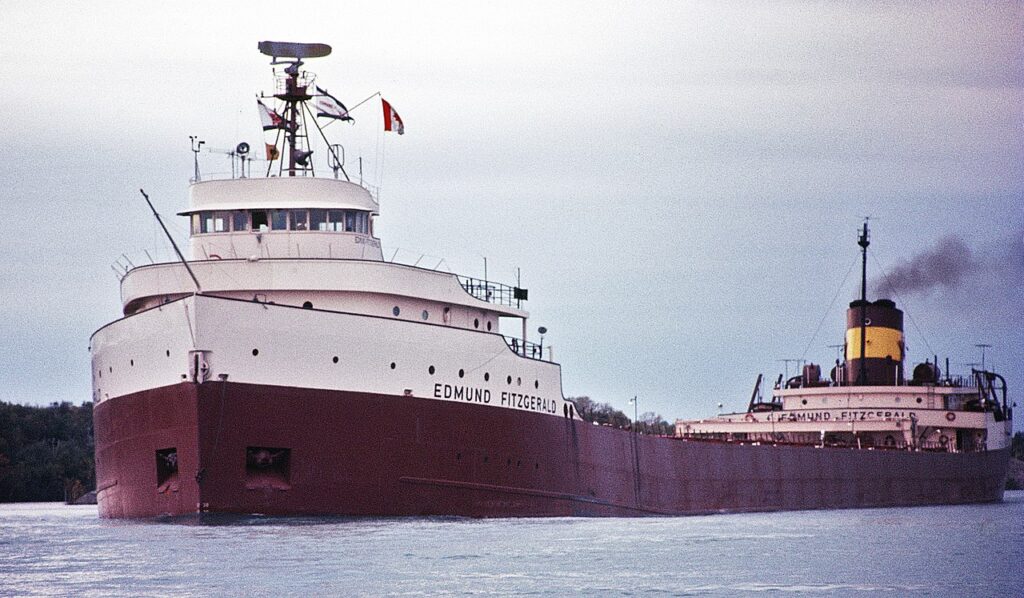
On November 10th, 1975, at approximately 7:15 PM Eastern Standard Time, the Great Lakes ore carrier SS Edmund Fitzgerald was lost in an unseasonably strong storm, taking all 29 hands with her. She wasn’t the first, nor the last of these ore carriers to go down, but for 50 years, many have remembered this event which, somehow, struck a chord with so many of us.
Certainly, a big part of the living memory of this tragedy as a part of the cultural zeitgeist exists due to the 1976 Gordon Lightfoot Song “Wreck of the Edmund Fitzgerald” which tells the tale of the ships final voyage and what the crew may have experienced in those final hours.
Indeed, it’s a story that’s been told a thousand times. A story of a crew operating a ship carrying a little over 26,000 tons of taconite iron ore from Superior, Wisconsin to Detroit, Michigan –a distance of about 1000 miles along the routes available in the Great Lakes. Late on the second day of the voyage, almost halfway through her route, and coming upon Whitefish Point, Michigan, the already rough weather had turned south quickly and, by 7:15 PM the evening of the 10th, contact was lost. The ship, and her crew, were gone.
No survivors were found, nor anything much more on the surface than some debris, one inflatable life raft that had indeed been inflated, but no signs of the ship or her crew until November 12th — two days after the loss of contact — when the William Clay Ford found the remains of the ship split in two on the lake bottom. No bodies were found, but in conjunction with the one inflated life raft found on the surface, it was noticed that a side door on the wheelhouse was open, and in a state that it would have been opened by the crew. That, combined with the raft hints at a story known only to Lake Superior — one of an attempt at survival when nature itself, in a very real sense, swallowed the ship and the crew, never to give them up.
29 Men died, simply doing their jobs. While certainly not the normal 9 to 5 by any means, they were normal working men like the rest of us. Fathers. Sons. Brothers. Parents. Children. All men connected to other people, as we all are, who were simply trying to do their jobs and keep industry flowing with a fresh load of iron ore that would never make it to its destination. 29 Men who would never come home again, forever, in a sense, forever underway in the collective memory of so many of us.
The story of the Edmund Fitzgerald has come to embody all of the risks associated with shipping along the Great Lakes, and, in a broader sense, the risks many people take to ensure society keeps on going, in one facet or another. Remember, however, these were real people with real lives, who were lost 50 years ago today, with the publication of this article set to the time of last contact with the ship – 7:15 PM Eastern Standard Time.
It is my hope that their story continues forward through the generations.
https://ssedmundfitzgerald.org/crewtribute
Michael Armagost
Frederick Beetcher
Thomas Bentsen
Edward Bindon
Thomas Borgeson
Oliver Champeau
Nolan Church
Ransom Cundy
Thomas Edwards
Russell Haskell
George Holl
Bruce Hudson
Allen Kalmon
Gordon MacLellan
Joseph Mazes
John McCarthy
Ernest McSorley
Eugene O’Brien
Karl Peckol
John Poviach
James Pratt
Robert Rafferty
Paul Riippa
John Simmons
William Spengler
Mark Thomas
Ralph Walton
David Weiss
Blaine Wilhelm
As an aside, this post was published at the exact time of the loss of contact with the ship immediately before its sinking.